
5 min read
Data as a Product: Turning Raw Data into Strategic Assets
Explore the “data as a product” approach: package data with governance, documentation and quality for faster insights, greater trust and new value.

January 6, 2026


The latest articles, news, blogs and learnings from Databahn


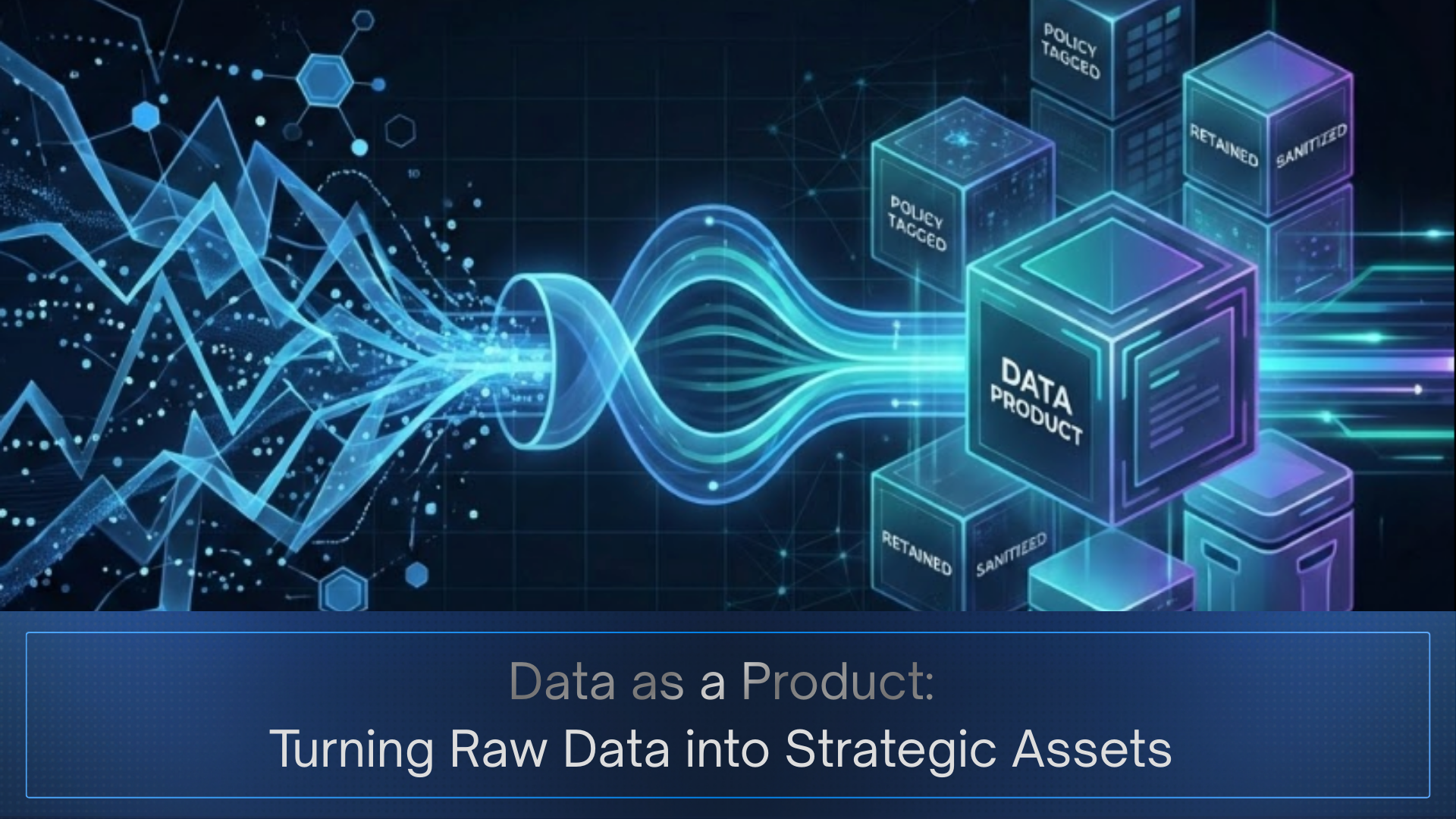
Modern organizations generate vast quantities of data – on the order of ~400 million terabytes per day (≈147 zettabytes per year) – yet most of this raw data ends up unused or undervalued. This “data deluge” spans web traffic, IoT sensors, cloud services and more (IoT devices alone exceeds 21 billion by 2025), overwhelming traditional analytics pipelines. At the same time, surveys show a data trust gap: 76% of companies say data-driven decisions are a top priority, but 67% admit they don’t fully trust their data. In short, while data volumes and demand for insights grow exponentially, poor quality, hidden lineage, and siloed access make data slow to use and hard to trust.
In this context, treating data as a product offers a strategic remedy. Rather than hoarding raw feeds, organizations package key datasets as managed “products” – complete with owners, documentation, interfaces and quality guarantees. Each data product is designed with its end-users (analysts, apps or ML models) in mind, just like a software product. The goal is to make data discoverable, reliable and reusable, so it delivers consistent business value over time. Below we explain this paradigm, its benefits, and the technical practices (and tools like Databahn’s Smart Edge and Data Fabric) that make it work.
Treating data as a product means applying product-management principles to data assets. Each dataset or analytic output is developed, maintained and measured as if it were a standalone product offering. This involves explicit ownership, thorough documentation, defined SLAs (quality/reliability guarantees), and intuitive access. In practice:
· Clear Ownership and Accountability: Every data product has a designated owner (or team) responsible for its accuracy, availability and usability. This prevents the “everyone and no one” problem. Owners ensure the data remains correct, resolves issues quickly, and drives continuous improvements.
· Thoughtful Design & Documentation: Data products are well-structured and user-friendly. Schema design follows conventions, fields are clearly defined, and usage guidelines are documented. Like good software, data products provide metadata (glossaries, lineage, usage examples) so consumers understand what the data represents and how to use it.
· Discoverability: A data product must be easy to find. Rather than hidden in raw tables, it’s cataloged and searchable by business terms. Teams invest in data catalogs or marketplaces so users can locate products by use case or domain (not just technical name). Semantic search, business glossaries, and lineage links help ensure relevant products surface for the right users.
· Reusability & Interoperability: Data products are packaged to be consumed by multiple teams and tools (BI dashboards, ML models, apps, etc.). They adhere to standard formats and APIs, and include provenance/lineage so they can be reliably integrated across pipelines. In other words, data products are “API-friendly” and designed for broad reuse rather than one-off scripts or spreadsheets.
· Quality and Reliability Guarantees: A true data product comes with service-level commitments: guarantees on freshness, completeness and accuracy. It includes built-in validation tests, monitoring and alerting. If data falls outside accepted ranges or pipelines break, the system raises alarms immediately. This ensures the product is dependable – “correct, up-to-date and consistent”. By treating data quality as a core feature, teams build trust: users know they can rely on the product and won’t be surprised by stale or skewed values.
Together these traits align to make data truly “productized” – discoverable, documented, owned and trusted. For example, IBM notes that in a Data-as-a-Product model each dataset should be easy to find, well-documented, interoperable with other data products and secure.
Shifting to this product mindset yields measurable business and operational benefits. Key gains include:
· Faster Time to Insight: When data is packaged and ready-to-use, analytics teams spend less time wrangling raw data. In fact, companies adopting data-product practices have seen use cases delivered up to 90% faster. By pre-cleaning, tagging and curating data streams, teams eliminate manual ETL work and speed delivery of reports and models. For example, mature data-product ecosystems let new analytics projects spin up in days rather than weeks because the underlying data products (sales tables, customer 360 views, device metrics, etc.) are already vetted and documented. Faster insights translate directly into agility – marketing can target trends more rapidly, fraud can be detected in real time, and product teams can A/B test features without waiting on fresh data.
· Improved Data Trust: As noted, a common problem is lack of trust. Treating data as a product instills confidence: well-governed, monitored data products reduce errors and surprises. When business users know who “owns” a dataset, and see clear documentation and lineage, they’re far more likely to rely on it for decision-making. Gartner and others have found that only a fraction of data meets quality standards, but strong data governance and observability closes that gap. Building products with documented quality checks directly addresses this issue: if an issue arises, the owner is responsible for fixing it. Over time this increases overall data trust.
· Cost Reduction: A unified data-product approach can significantly cut infrastructure and operational costs. By filtering and curating at the source, organizations avoid storing and processing redundant or low-value data. McKinsey research showing that using data products can reduce data ownership costs by around 30%. In security use cases, Data Fabric implementations have slashed event volumes by 40–70% by discarding irrelevant logs. This means smaller data warehouses, lower cloud bills, and leaner analytics pipelines. In addition, automation of data quality checks and monitoring means fewer human hours spent on firefighting – instead engineers focus on innovation.
· Cross-Team Enablement and Alignment: When data is productized, it becomes a shared asset across the business. Analysts, data scientists, operations and line-of-business teams can all consume the same trusted products, rather than building siloed copies. This promotes consistency and prevents duplicated effort. Domain-oriented ownership (akin to data mesh) means each business unit manages its own data products, but within a federated governance model, which aligns IT controls with domain agility. In practice, teams can “rent” each other’s data products: for example, a logistics team might use a sales data product to prioritize shipments, or a marketing team could use an IoT-derived telemetry product to refine targeting.
· New Revenue and Monetization Opportunities: Finally, viewing data as a product can enable monetization. Trusted, well-packaged data products can be sold or shared with partners and customers. For instance, a retail company might monetize its clean location-history product or a telecom could offer an anonymized usage dataset to advertisers. Even internally, departments can chargeback usage of premium data services. While external data sales is a complex topic, having a “product” approach to
data makes it possible in principle – one already has the “catalog, owner, license and quality” components needed for data exchanges.
In summary, the product mindset moves organizations from “find it and hope it works” to “publish it and know it works”. Insights emerge more quickly, trust in data grows, and teams can leverage shared data assets efficiently. As one industry analysis notes, productizing data leads to faster insights, stronger governance, and better alignment between data teams and business goals.
Building a data-product ecosystem requires disciplined processes, tooling, and culture. Below are technical pillars and best practices to implement this model:
· Data Governance & Policies: Governance is not a one-time task but continuous control over data products. This includes access controls (who can read/write each product), compliance rules (e.g. masking PII, GDPR retention policies) and stewardship workflows. Governance should be embedded in the pipeline: for example, only authorized users can subscribe to certain data products, and policies are enforced in-flight. Many organizations adopt federated governance: central data teams set standards and guardrails (for metadata management, cataloging, quality SLAs), while domain teams enforce them on their products. A modern data catalog plays a central role here, storing schemas, SLA definitions, and lineage info for every product. Automating metadata capture is key – tools should ingest schemas, lineage and usage metrics into the catalog, ensuring governance information stays up-to-date.
· Pipeline and Architecture Design: Robust pipeline architecture underpins data products. Best practices include:
· Lineage Tracking and Metadata: Centralize full data lineage for every product. Lineage captures each data product’s origin and transformations (e.g. tables joined, code versions, filters applied). This enables impact analysis (“which products use this table?”), audit trails, and debugging. For instance, if a business metric is suddenly off, lineage lets you trace back to which upstream data change caused it. Leading tools automatically capture lineage metadata during ETL jobs and streaming, and feed it into the catalog or governance plane. As IBM notes, data lineage is essential so teams “no longer wonder if a rule failed because the source data is missing or because nothing happened”.
· Data Quality & Observability: Embed quality checks throughout the pipeline. This means validating schema, detecting anomalies (e.g. volume spikes, null rates) and enforcing SLAs at ingestion time, not just at the end. Automated tests (using frameworks like Great Expectations or built-in checks) should run whenever data moves between layers. When issues arise, alert the owner via dashboards or notifications. Observability tools track data quality metrics; when thresholds are breached, pipelines can auto-correct or quarantine the output. Databahn’s approach exemplifies this: its Smart Edge runs real-time health checks on telemetry streams, guaranteeing “zero data loss or gaps” even under spikes.
· Security & Compliance: Treat security as part of the product. Encrypt sensitive data, apply masking or tokenization, and use role-based access to restrict who can consume each product. Data policies (e.g. for GDPR, HIPAA) should be enforced in transit. For example, Databahn’s platform can identify and quarantine sensitive fields in flight before data reaches a data lake. In a product mindset, compliance controls (audit logs, masking, consent flags) are packaged with the product – users see a governance tag and know its privacy level upfront.
· Continuous Improvement and Lifecycle Management: Finally, a data product is not “set and forget.” It should have a lifecycle: owners gather user feedback, add features (new fields, higher performance), and retire the product when it no longer adds value. Built-in metrics help decide when a product should evolve or be sunset. This prevents “data debt” where stale tables linger unused.
These implementation practices ensure data products are high-quality and maintainable. They also mirror practices from modern DevOps and data-mesh teams – only with data itself treated as the first-class entity.
Adopting a “data as a product” model is a strategic shift. It requires cultural change (breaking down silos, instilling accountability) and investment in the right processes and tools. But the payoffs are significant: drastically faster analytics, higher trust in data, lower costs, and the ability to scale data-driven innovation across teams.
.png)
In many enterprises today, a wealth of security telemetry sits locked away in engineering-centric systems. Only the SIEM engineers or data teams can directly query raw logs, leaving other stakeholders waiting in line for reports or context. Bringing security data to business users – whether they are threat hunters, compliance auditors, or CISOs needing quick insights – can dramatically improve decision-making. But unlocking data access broadly isn’t as simple as opening the floodgates. It must be done without compromising data integrity, compliance, or cost. In this post, we explore how security and IT organizations can democratize analytics and make telemetry accessible beyond just engineers, all while enforcing quality guardrails and governance.
Despite collecting more security data than ever, organizations often struggle to make it useful beyond a few expert users. Several barriers block broader access:
In short, security data often remains an engineer’s asset, not an enterprise asset. But the cost of this status quo is high: valuable insights stay trapped, analysts waste time on data plumbing rather than hunting threats, and decisions get made with partial information. The good news is that forward-thinking teams are realizing it doesn’t have to be this way.
Enabling a wider range of internal users to access telemetry and security data – with proper controls – can significantly enhance security operations and business outcomes:
In essence, making security telemetry accessible beyond engineers turns data into a strategic asset. It ensures that those who need insights can get them, and it fosters a culture where decisions are based on evidence from real security data. However, to achieve this utopia, we must address the very real concerns around quality, governance, and cost.
How can organizations enable broad data access without creating chaos? The answer lies in building a foundation that prepares and governs telemetry at the data layer – often called a security data pipeline or security data fabric. Platforms like Databahn’s take the approach of sitting between sources and users (or tools), automatically handling the heavy lifting of data engineering so that business users get clean, relevant, and compliant data by default. Key capabilities include:
By implementing these capabilities, security and IT organizations turn their telemetry into a well-governed, self-service analytics layer. The effect is dramatic. Teams that have adopted security data pipeline platforms see outcomes like: 70–80% less data volume (with no loss of signal), 50%+ lower SIEM costs, and far faster onboarding of new data sources. In one case, a financial firm was able to onboard new logs 70% faster and cut $390K from annual SIEM spend after deploying an intelligent pipeline. Another enterprise shrunk its daily ingest by 80%, saving roughly $295K per year on SIEM licensing. These real-world gains show that simplifying and controlling data upstream has both operational and financial rewards.
While “data democratization” is a worthy goal, it must be paired with strong guardrails. Free access to bad or uncontrolled data helps no one. To responsibly broaden data access, consider these critical safeguards (baked into the platform or process):
With these guardrails in place, opening up data access is no longer a risky proposition. It becomes a managed process of empowering users while maintaining control. Think of it like opening more lanes on a highway but also adding speed limits, guardrails, and clear signage – you get more traffic flow, safely.
Expanding access to security telemetry unlocks meaningful operational value, but it requires structured execution. Begin by defining a common schema and governance process to maintain data consistency. Strengthen upstream data engineering so telemetry arrives parsed, enriched, and normalized, reducing manual overhead and improving analyst readiness. Use data tiering and routing to control storage costs and optimize performance across SIEM, data lakes, and downstream analytics.
Treat the pipeline as a product with full observability, ensuring issues in data flow or parsing are identified early. Apply role-based access controls and privacy safeguards to balance accessibility with compliance requirements. Finally, invest in user training and provide standardized queries and dashboards so teams can derive insights responsibly and efficiently.
With these priorities in place, organizations can broaden access to security data while preserving integrity, governance, and cost-efficiency – enabling faster decisions and more effective threat detection across the enterprise.
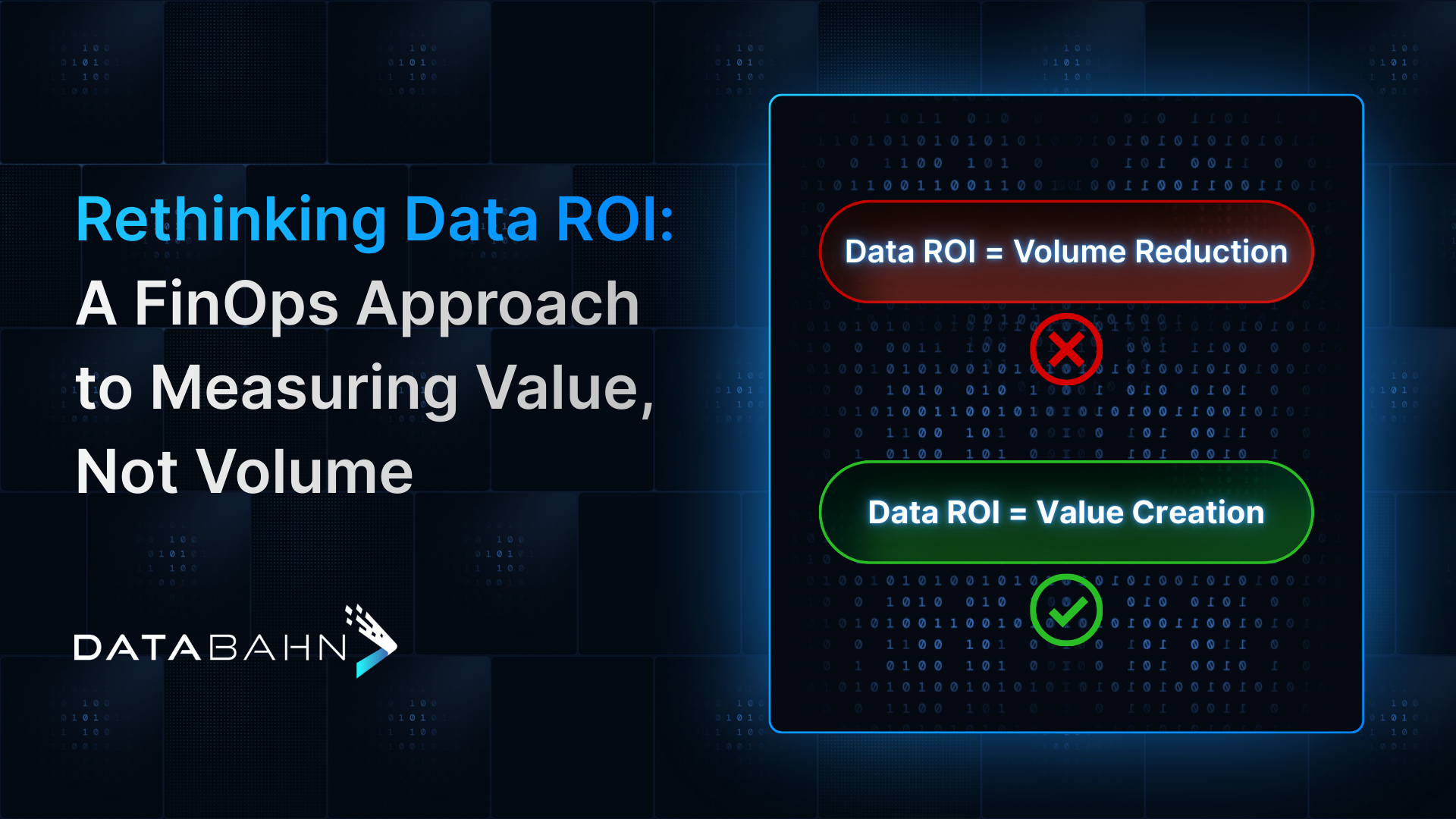
ROI is the metric that shows up in dashboards, budget reviews, and architecture discussions because it’s easy to measure and easy to attribute. Lower GB/day. Fewer logs. Reduced SIEM bills. Tighter retention.
But this is only the cost side of the equation — not the value side.
This mindset didn’t emerge because teams lack ambition. It emerged because cloud storage, SIEM licensing, and telemetry sprawl pushed everyone toward quick, measurable optimizations. Cutting volume became the universal lever, and over time, it began to masquerade as ROI itself.
The problem is simple: volume reduction says nothing about whether the remaining data is useful, trusted, high-quality, or capable of driving outcomes. It doesn’t tell you whether analysts can investigate faster, whether advanced analytics or automation can operate reliably, whether compliance risk is dropping, or whether teams across the business can make better decisions.
And that’s exactly where the real return lies.
Modern Data ROI must account for value extracted, not just volume avoided — and that value is created upstream, inside the pipeline, long before data lands in any system.
To move forward, we need to expand how organizations think about Data ROI from a narrow cost metric into a strategic value framework.
For most teams, reducing telemetry volume feels like the responsible thing to do. SIEM bills are rising, cloud storage is growing unchecked, and observability platforms charge by the event. Cutting data seems like the obvious way to protect the budget.
But here’s the problem: Volume is a terrible proxy for value.
When reductions are driven purely by cost, teams often remove the very signals that matter most — authentication context, enriched DNS fields, deep endpoint visibility, VPC flow attributes, or verbose application logs that power correlation. These tend to be high-volume, and therefore the first to get cut, even though they carry disproportionately high investigative and operational value.
And once those signals disappear, things break quietly:
All because the reduction was based on size, not importance.
Teams don’t cut the wrong data intentionally — they do it because they’ve never had a structured way to measure what each dataset contributes to security, reliability, or business outcomes. Without a value framework, cost becomes the default sorting mechanism.
This is where the ROI conversation goes off the rails. When decisions are made by volume instead of value, “saving” money often creates larger downstream costs in investigations, outages, compliance exposure, and operational inefficiency.
To fix this, organizations need a broader definition of ROI — one that captures what data enables, not just what it costs.
Many organizations succeed at reducing ingestion volume. SIEM bills come down. Storage growth slows. On paper, the cost problem looks addressed. Yet meaningful ROI often remains elusive.
The reason is simple: cutting volume manages cost, but it doesn’t manage value.
When reductions are applied without understanding how data is used, high-value context is often removed alongside low-signal noise. Detections become harder to validate. Investigations slow down. Pipelines remain fragmented, governance stays inconsistent, and engineering effort shifts toward maintaining brittle flows instead of improving outcomes. The bill improves, but the return does not.
To move forward, organizations need a broader definition of Data ROI, one that aligns more closely with FinOps principles. FinOps isn’t about minimizing spend in isolation. It’s about evaluating spend in the context of the value it creates.
Data ROI shows up in:
When these dimensions are considered together, the ROI question shifts from how much data was cut to how effectively data drives outcomes.
This shift from cost control to value creation is what sets the stage for a different approach to pipelines, one designed to protect, amplify, and sustain returns.
The impact of a value-driven pipeline becomes most visible when you look at how it changes day-to-day outcomes.
Consider a security team struggling with rising SIEM costs. Instead of cutting volume across the board, they rework ingestion to preserve high-value authentication, network, and endpoint context while trimming redundant fields and low-signal noise. Ingest costs drop, but more importantly, detections improve. Alerts become easier to validate; investigations move faster, and analysts spend less time chasing incomplete events.
In observability environments, the shift is similar. Application and infrastructure logs are routed with intent. High-resolution data stays available during incidents, while routine operational exhaust is summarized or routed to lower-cost storage. Reliability teams retain the context they need during outages without paying premium rates for data they rarely touch. Mean time to resolution improves even as overall spend stabilizes.
The same pattern applies to compliance and audit workflows. When privacy controls, lineage, and routing rules are enforced in the pipeline, teams no longer scramble to reconstruct how data moved or where sensitive fields were handled. Audit preparation becomes predictable, repeatable, and far less disruptive.
Across these scenarios, ROI doesn’t show up as a single savings number. It shows up as faster investigations, clearer signals, reduced operational drag, and confidence that critical data is available when it matters.
That is the difference between cutting data and managing it for value.
Data volumes will continue to grow. Telemetry, logs, and events are becoming richer, more frequent, and more distributed across systems. Cost pressure is not going away, and neither is the need to control it.
But focusing solely on how much data is cut misses the larger opportunity. Real ROI comes from what data enables: faster investigations, better operational decisions, predictable compliance, and systems that teams can trust when it matters most.
Modern Data Pipeline Management reframes the role of pipelines from passive transport to active value creation. When data is shaped with intent, governed in motion, and reused across teams, every downstream system benefits. Cost efficiency follows naturally, but it is a byproduct, not the goal.
The organizations that succeed in the FinOps era will be those that treat data as an investment, not an expense. They will measure ROI not by the terabytes they avoided ingesting, but by the outcomes their data consistently delivers.
.png)
In modern architectures, data protection needs to begin much earlier.
Enterprises now move continuous streams of logs, telemetry, cloud events, and application data across pipelines that span clouds, SaaS platforms, and on-prem systems. Sensitive information often travels through these pipelines in raw form, long before minimization or compliance rules are applied. Every collector, transformation, and routing decision becomes an exposure point that downstream controls cannot retroactively fix.
Recent breach data underscores this early exposure. IBM’s 2025 Cost of a Data Breach Report places the average breach at USD 4.44 million, with 53% involving customer PII. The damage to data protection becomes visible downstream, but the vulnerability often begins upstream, inside fast-moving and lightly governed dataflows.
As architectures expand and telemetry becomes more identity-rich, the “protect later” model breaks down. Logs alone contain enough identifiers to trigger privacy obligations, and once they fan out to SIEMs, data lakes, analytics stacks, and AI systems, inconsistencies multiply quickly.
This is why more teams are adopting privacy by design in the pipeline – enforcing governance at ingestion rather than at rest. Modern data pipeline management platforms, like Databahn, make this practical by applying policy-driven transformations directly within data flows.
If privacy isn’t enforced in motion, it’s already at risk.
Modern data environments are deeply fractured. Enterprises combine public cloud, private cloud, on-prem systems, SaaS platforms, third-party vendors, identity providers, and IoT or OT devices. IBM’s analysis shows many breaches involve data that spans multiple environments, which makes consistent governance difficult in practice.
Downstream privacy breaks for three core reasons.
1. Data moves more than it rests.
Logs, traces, cloud events, user actions, and identity telemetry are continuously routed across systems. Data commonly traverses several hops before landing in a governed system. Each hop expands the exposure surface, and protections applied later cannot retroactively secure what already moved.
2. Telemetry carries sensitive identifiers.
A 2024 study of 25 real-world log datasets found identifiers such as IP addresses, user IDs, hostnames, and MAC addresses across every sample. Telemetry is not neutral metadata; it is privacy-relevant data that flows frequently and unpredictably.
3. Downstream systems see only fragments.
Even if masking or minimization is applied in a warehouse or SIEM, it does nothing for data already forwarded to observability tools, vendor exports, model training systems, sandbox environments, diagnostics pipelines, or engineering logs. Late-stage enforcement leaves everything earlier in the flow ungoverned.
These structural realities explain why many enterprises struggle to deliver consistent privacy guarantees. Downstream controls only touch what eventually lands in governed systems; everything before that remains exposed.
Once organizations recognize that exposure occurs before data lands anywhere, the pipeline becomes the most reliable place to enforce data protection and privacy. It is the only layer that consistently touches every dataset and every transformation regardless of where that data eventually resides.
1. One ingestion, many consumers
Modern data pipelines often fan out: one collector feeds multiple systems – SIEM, data lake, analytics, monitoring tools, dashboards, AI engines, third-party systems. Applying privacy rules only at some endpoints guarantees exposure elsewhere. If control is applied upstream, every downstream consumer inherits the privacy posture.
2. Complex, multi-environment estates
With infrastructure spread across clouds, on-premises, edge and SaaS, a unified governance layer is impractical without a central enforcement choke point. The pipeline – which by design spans environments – is that choke point.
3. Telemetry and logs are high-risk by default
Security telemetry often includes sensitive identifiers: user IDs, IP addresses, resource IDs, file paths, hostname metadata, sometimes even session tokens. Once collected in raw form, that data is subject to leakage. Pipeline-level privacy lets organizations sanitize telemetry as it flows in, without compromising observability or utility.
4. Simplicity, consistency, auditability
When privacy is enforced uniformly in the pipeline, rules don’t vary by downstream system. Governance becomes simpler, compliance becomes more predictable, and audit trails reliably reflect data transformations and lineage.
This creates a foundation that downstream tools can inherit without additional complexity, and modern platforms such as Databahn make this model practical at scale by operationalizing these controls directly in data flows.
Implementing privacy in motion starts with operational steps that can be applied consistently across every dataflow. A clear framework helps teams standardize how sensitive data is detected, minimized, and governed inside the pipeline.
1. Detect sensitive elements early
Identify PII, quasi-identifiers, and sensitive metadata at ingestion using schema-aware parsing or lightweight classifiers. Early detection sets the rules for everything that follows.
2. Minimize before storing or routing
Mask, redact, tokenize, or drop fields that downstream systems do not need. Inline minimization reduces exposure and prevents raw data from spreading across environments.
3. Apply routing based on sensitivity
Direct high-sensitivity data to the appropriate region, storage layer, or set of tools. Produce different versions of the same dataset, when necessary, such as a masked view for analytics or a full-fidelity view for security.
4. Preserve lineage and transformation context
Attach metadata that records what was changed, when it was changed, and why. Downstream systems inherit this context automatically, which strengthens auditability and ensures consistent compliance behavior.
This framework keeps privacy enforcement close to where data begins, not where it eventually ends.
Regulatory expectations around data privacy have expanded rapidly, and modern telemetry streams now fall squarely within that scope. Regulations such as GDPR, CCPA, PCI, HIPAA, and emerging sector-specific rules increasingly treat operational data the same way they treat traditional customer records. The result is a much larger compliance footprint than many teams anticipate.
The financial impact reflects this shift. DLA Piper’s 2025 analysis recorded more than €1.2 billion in GDPR fines in a single year, an indication that regulators are paying close attention to how data moves, not just how it is stored.
Pipeline-level privacy simplifies compliance by:
By shifting privacy controls to the pipeline layer, organizations avoid accidental exposures and reduce the operational burden of managing compliance tool by tool.
Embedding privacy controls directly in the pipeline does more than reduce risk. It produces measurable operational advantages that improve efficiency across security, data, and engineering teams.
1. Lower storage and SIEM costs
Upstream minimization reduce GB/day before data reaches SIEMs, data lakes, or long-term retention layers. When unnecessary fields are masked or dropped at ingestion, indexing and storage footprints shrink significantly.
2. Higher-quality detections with less noise
Consistent normalization and redaction give analytics and detection systems cleaner inputs. This reduces false positives, improves correlation across domains, and strengthens threat investigations without exposing raw identifiers.
3. Safer and faster incident response
Role-based routing and masked operational views allow analysts to investigate alerts without unnecessary access to sensitive information. This lowers insider risk and reduces regulatory scrutiny during investigations.
4. Easier compliance and audit readiness
Lineage and transformation metadata captured in the pipeline make it simple to demonstrate how data was governed. Teams spend less time preparing evidence for audits because privacy enforcement is built into the dataflow.
5. AI adoption with reduced privacy exposure
Pipelines that minimize and tag data at ingestion ensure AI models ingest clean, contextual, privacy-safe inputs. This reduces the risk of model training on sensitive or regulated attributes.
6. More predictable governance across environments
With pipeline-level enforcement, every downstream system inherits the same privacy posture. This removes the drift created by tool-by-tool configurations.
A pipeline that governs data in motion delivers both security gains and operational efficiency, which is why more teams are adopting this model as a foundational practice.
Most privacy failures do not originate in the systems that store or analyze data. They begin earlier, in the movement of raw logs, telemetry, and application events through pipelines that cross clouds, tools, and vendors. When sensitive information is collected without guardrails and allowed to spread, downstream controls can only contain the damage, not prevent it.
Embedding privacy directly into the pipeline changes this dynamic. Inline detection, minimization, sensitivity-aware routing, and consistent lineage turn the pipeline into the first and most reliable enforcement layer. Every downstream consumer inherits the same governed posture, which strengthens security, simplifies compliance, and reduces operational overhead.
Modern data ecosystems demand privacy that moves with the data, not privacy that waits for it to arrive. Treating the pipeline as a control surface provides that consistency. When organizations govern data at the point of entry, they reduce risk from the very start and build a safer foundation for analytics and AI.
“We need to add 100+ more applications to our SIEM, but we have no room in our license. We have to migrate to a cheaper SIEM,” said every enterprise CISO. With 95%+ usage of their existing license – and the new sources projected to add 60% to their log volume – they had to migrate. But the reluctance was so obvious; they had spent years making this SIEM work for them. “It understands us now, and we’ve spent years to make it work that way,” said that Director for Security Operations.
They had spent years compensating for the complexity of the old system, and turned it into a skillset.
Their threat detection and investigation team had mastered its query language. The data engineering team had built configuration rules, created complex parsers, and managed the SIEM’s field extraction quirks and fragmented configuration model. They were proud of what they had built, and rightfully so. But today, that expertise had become a barrier. Security teams today are still investing their best talent and millions of dollars in mastering complexity because their tools never invested enough in making things simple.
Operators are expected to learn a vendor’s language, a vendor’s model, a vendor’s processing pipeline, and a vendor’s worldview. They are expected to stay updated with the vendor’s latest certifications and features. And over time, that mastery becomes a requirement to do the job. And at an enterprise level, it becomes a cage.
This is the heart of the problem. Ease of use is a burden security teams are taking upon themselves, because vendors are not.
In enterprise security, complexity often becomes a proxy for capability. If a tool is difficult to configure, we assume it must be powerful. If a platform requires certifications, we assume it must be deep. If a pipeline requires custom scripting, we assume that is what serious engineering looks like.
This slow, cultural drift has shaped the entire landscape.
Security platforms leaned on specialized query languages that require months of practice. SIEMs demanded custom transformation and parsing logic that must be rebuilt for every new source. Cloud security tools introduced their own rule engines and ingestion constraints. Observability platforms added configuration models that required bespoke tuning. Tools were not built to work in the way teams did; teams had to be built in a way to make the tool work.
Over time, teams normalized this expectation. They learned to code around missing features. They glued systems together through duct-tape pipelines. They designed workarounds when vendor interfaces fell short. They memorized exceptions, edge cases, and undocumented behaviors. Large enterprises built complex workflows and systems, customized and personalized software that cost millions to operate out of the box, and invested millions more of their talent and expertise to make it usable.
Not because it was the best way to operate. But because the industry never offered alternatives.
The result is an ecosystem where talent is measured by the depth of tool-specific knowledge, not by architectural ability or strategic judgment. A practitioner who has mastered a single platform can feel trapped inside it. A CISO who wants modernization hesitates because the existing system reflects years of accumulated operator knowledge. A detection engineer becomes the bottleneck because they are the only one who can make sense of a particular piece of the stack.
This is not the fault of the people. This is the cost of tools that never prioritized usability.
When a team is forced to become experts in tool complexity, several hidden problems emerge.
First, tool dependence becomes talent dependence. If only a few people can maintain the environment, then the environment cannot evolve. This limits the organization’s ability to adopt new architectures, onboard new data sources, or adjust to changing business requirements.
Second, vendor lock-in becomes psychological, not just contractual. The fear of losing team expertise becomes a bigger deterrent than licensing or performance issues.
Third, practitioners spend more time repairing the system than improving it. Much of their effort goes into maintaining the rituals the tool requires rather than advancing detection coverage, improving threat response, or designing scalable data architectures.
Fourth, data ownership becomes fragmented. Teams rely heavily on vendor-native collectors, parsers, rules, and models, which limits how and where data can move. This reduces flexibility and increases the long-term cost of security analytics.
These patterns restrict growth. They turn security operations into a series of compensations. They push practitioners to specialize in tool mechanics instead of the broader discipline of security engineering.
There is a misconception that making a platform simpler somehow reduces its capability or seriousness. But in every other field, from development operations to data engineering, ease of use is recognized as a strategic accelerator.
Security has been slow to adopt this view because complexity has been normalized for so long. But ease of use is not a compromise. It is a requirement for adaptability, resilience, and scale.
A platform that is easy to use enables more people to participate in the architecture. It allows senior engineers to focus on high-impact design instead of low-level maintenance. It ensures that talent is portable and not trapped inside one tool’s ecosystem. It reduces onboarding friction. It accelerates modernization. It reduces burnout.
And most importantly, it allows teams to focus on the job to be done rather than the tool to be mastered. At a time when experienced security personnel are needed, when burnout is an acknowledged and significant challenge in the security industry, and while security budgets continue to fall short of where they need to be, removing tool-based filters and limitations would be extremely useful.
This is an instance where AI doesn’t hog the headline, but plays an important role nonetheless. AI can automate a lot of the high-effort, low-value work that we’re referring to. It can help automate parsing, data engineering, quality checks, and other manual flows that created knowledge barriers and necessitated certifications in the first place.
At Databahn, AI has already simplified the process of detecting data, building pipelines, creating parsers, tracking data quality, managing telemetry health, fixing schema drift, and quarantining PII. But AI is not the point – it’s a demonstration of what the industry has been missing. AI helps show that years of accumulated tool complexity – particularly in bridging the gap between systems, data streams, and data silos – were not inevitable. They were simply unmet customer needs, where the gaps were filled by extremely talented technical talent, which was forced to expend their effort doing this instead of strategic work.
In response to these pressures, several large security vendors have taken a different approach. Instead of rethinking complexity, they have begun consolidating tools through acquisition, bundling SIEM, SOAR, EDR, cloud security, data lakes, observability, and threat analytics into a single ecosystem. On the surface, this appears to solve the usability problem. One login. One workflow. One vendor relationship. One neatly integrated stack.
But this model rarely delivers the simplicity it promises.
Each acquired component carries its own legacy. Each tool inside the stack has its own schema, its own integration style, its own operational boundaries, and its own quirks. Teams still need to learn the languages and mechanics of the ecosystem; now there are simply more of them tucked under a single logo. The complexity has not disappeared. It has been centralized.
For some enterprises, this consolidation may create incremental improvements, especially for teams with limited engineering resources. But in the long term, it creates a deeper problem. The dependency becomes stronger. The lock-in becomes tighter. And the cost of leaving grows exponentially.
The more teams build inside these ecosystems, the more their processes, content, and institutional knowledge become inseparable from a vendor’s architecture. Every new project, every new parser, every new detection rule becomes another thread binding the organization to a specific way of operating. Instead of evolving toward data ownership and architectural flexibility, teams evolve within the constraints of a platform. Progress becomes defined by what the vendor offers, not by what the organization needs.
This is the opposite direction of where security must go. The future is not platform dependence. It is data independence. It is the ability to own, govern, transform, and route telemetry on your terms. It is the freedom to adapt tools to architecture, not architecture to tools. Consolidated ecosystems do not offer this freedom. They make it harder to achieve. And the longer an organization stays inside these consolidated stacks, the more difficult it becomes to reclaim that independence.
The CISO from the beginning of this piece evaluated Databahn in a POC. They were initially skeptical; their operators believed that no-code systems were shortcuts, and expected there to be strong trade-offs in capability, precision, and flexibility. They expected to outgrow the tool immediately.
When the Director of Security Operations logged into the tool and realized they could make a pipeline in a few minutes by themselves, they realized that they didn’t need to allocate the bandwidth of two full data engineers to operate Databahn and manage the pipeline. They also saw approximately 70% volume reduction, and could add those 100+ sources in 2 weeks, instead of a few months.
The SOC chose Databahn at the end of the POC. Surprisingly, they also chose to retain their old SIEM. They could more easily export their configurations, rules, systems, and customizations into Databahn and since license costs were low, the underlying reason to migrate disappeared. But now, they are not spending cycles building pipelines, connecting sources, applying transformations, and building complex queries or writing complex code. They have found that Databahn’s ease of use has not removed their expertise; it’s elevated it. The same operators who resisted Databahn are now advocates for it.
The team is now taking their time to design and build a completely new data architecture. They are now focused on using their years of expertise to build a future-proof security data system and architecture that meets their use case and is not constrained by the old barriers of tool-specific knowledge.
Security does not need more dependence on niche skills. It does not need more platforms that require specialized certifications. It does not need more pipelines that can only be understood by one or two experts.
Security needs tools that make expertise more valuable, not less. Tools that adapt to people and teams, not the other way around. Tools that treat ease of use as a core requirement, not a principle to be condescendingly ignored or selectively focused on people who already know how to use their tool.
Teams should not have to invest in mastering complexity. Tools should invest in removing it.
And when that happens, security becomes stronger, faster, and more adaptable. Talent becomes more portable and more empowered. Architecture becomes more scalable. And organizations regain their own control over their telemetry.
This shift is long overdue. But it is happening now, and the teams that embrace it will define the next decade of security operations.
Security teams today are drowning in data. Legacy SIEMs and monolithic SOC platforms choke on ever-growing log volumes, giving analysts too many alerts and too little signal. In practice, some organizations ingest terabytes of telemetry per day and see hundreds of thousands of alerts daily, yet roughly two-thirds of alerts go uninvestigated without security data fabrics. Traditional SIEM pricing (by gigabyte or event rate) and static collectors mean escalating bills and blind spots. The result is analyst fatigue, sluggish response, and “data silos” where tools don’t share a common context.
Monolithic SOC architectures were built for simpler times. They assume log volume = security, so every source is dumped into one big platform. This “collect-it-all” approach can’t keep up with modern environments. Cloud workloads, IoT/OT networks, and dynamic services churn out exponentially more telemetry, much of it redundant or low-value. Analysts get buried under noise. For example, up to 30% of a SOC analyst’s time can be wasted chasing false positives from undifferentiated data. Meanwhile, scaling a SIEM or XDR to handle that load triggers massive licensing and storage costs.
This architectural stress shows up in real ways: delayed onboarding of new data feeds, rules that can’t keep pace with cloud changes, gaps in compliance data, and “reactive” troubleshooting whenever ingestion spikes. In short, agility and scalability suffer. Security teams are increasingly asked to do more with less – deeper analytics, AI-driven hunting, and 24/7 monitoring – but are hamstrung by rigid, centralized tooling.
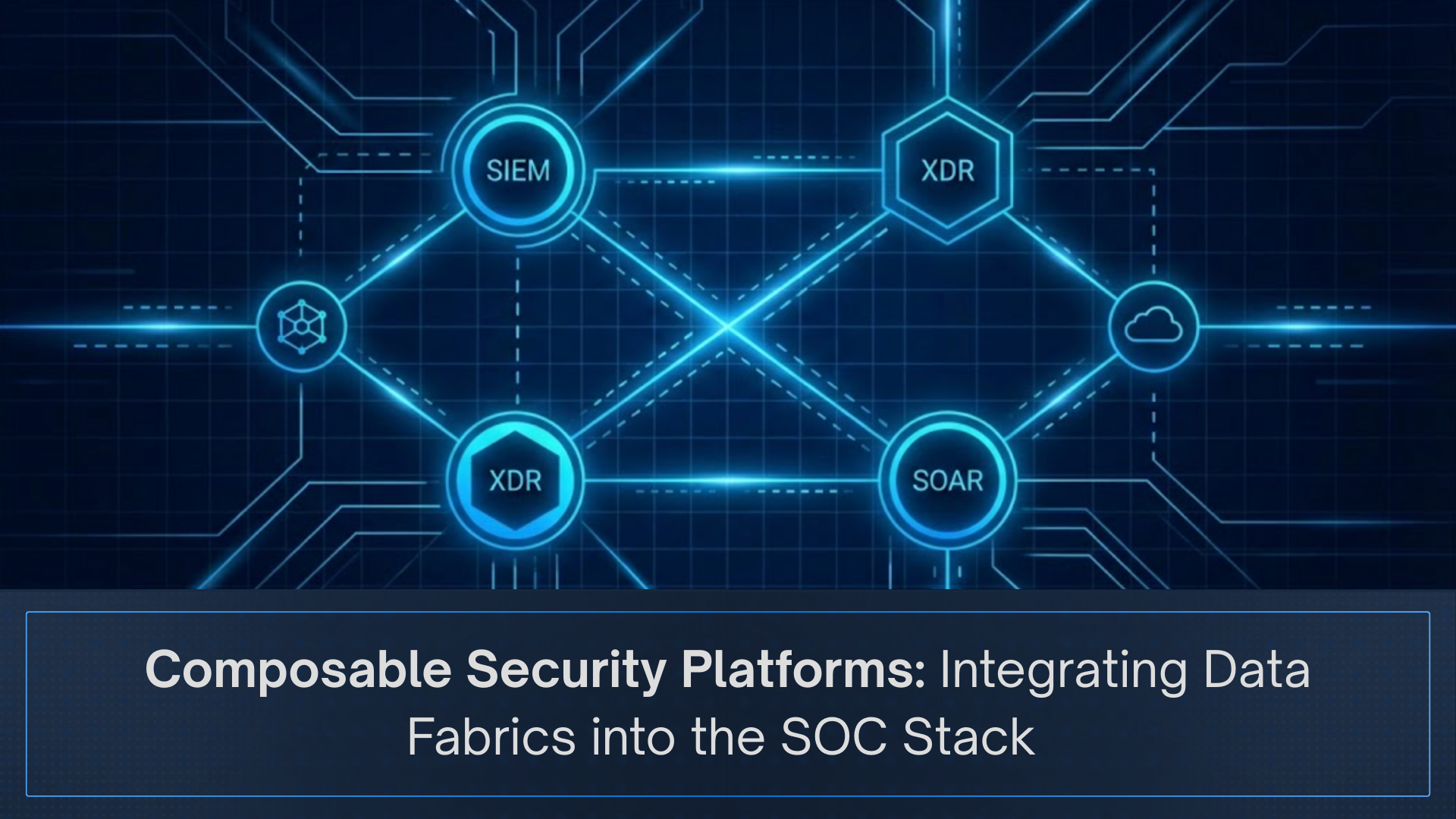
The broader IT world has already swung toward modular, API-driven design, and security is following suit. Analysts note that “the future SOC will not be one large, inflexible platform. It will be a modular architecture built from pipelines, intelligence, analytics, detection, and storage that can be deployed independently and scale as needed”. In other words, SOC stacks are decomposing: SIEM, XDR, SOAR and other components become interchangeable services instead of a single black box. This composable mindset – familiar from microservices and cloud-native design – enables teams to mix best-of-breed tools, swap vendors, and evolve one piece without gutting the entire system.
For example, enterprise apps are moving to cloud-native, service-based platforms (IDC reports ~80% of new apps on microservices.) because monoliths can’t scale. Security is on the same path. By decoupling data collection from analytics, and using standardized data contracts (schemas, APIs), organizations gain flexibility and resilience. A composable SOC can ingest new telemetry streams or adopt advanced AI models without forklift upgrades. It also avoids vendor lock-in: teams “want the freedom to route, store, enrich, analyze, and search without being forced into a single vendor’s path”.
This is where a security data fabric comes in. A data fabric is essentially a unified, virtualized pipeline that connects all parts of the SOC stack. As one expert puts it, a “security data fabric” is an architectural layer for collecting, correlating, and sharing security intelligence across disparate tools and sources in real time. In practice, the security datafabric ingests raw logs and telemetry from every source, applies intelligence and policies, and then forwards the curated streams to SIEMs, XDR platforms, SOAR engines or data lakes as needed. The goal is to ensure every tool has just the right data in the right form.
For example, a data fabric can normalize and enrich events at ingest time (adding consistent tags, schemas or asset info), so downstream tools all operate on the same language. It can also compress and filter data to lower volumes: many teams report cutting 40–70% of their SIEM ingestion by eliminating redundant or low-value. A data fabric typically provides:
These capabilities transform a SOC’s data flow. In one illustrative implementation, logs enter the fabric, get parsed and tagged in-stream, and are forked by policy: security-critical events go into the SIEM index, vast bulk archives into cheap object storage, and everything to a searchable data lake for hunting and machine learning. By handling normalization, parsing and even initial threat-scoring in the fabric layer, the SIEM/XDR can focus on analytics instead of housekeeping. Studies show that teams using such data fabrics routinely shrink SIEM ingest by tens of percent without losing visibility – freeing resources for the alerts that really matter.
By architecting the SOC stack this way, teams get resilience and agility. Each component (SIEM engine, XDR module, SOAR workflows, threat-hunting tools) plugs into the fabric rather than relying on point-to-point integrations. New tools can be slotted in (or swapped out) by simply connecting to the common data fabric. This composability also accelerates cloud adoption: for example, AWS Security Lake and other data lake services work as fabric sinks, ingesting contextualized data streams from any collector.
In sum, a security data fabric lets SOC teams control what data flows and where, rather than blindly ingesting everything. The payoffs are significant: faster queries (less noise), lower storage costs, and a more panoramic view of threats. In one case, a firm reduced SIEM data by up to 70% while actually enhancing detection rates, simply by forwarding only security-relevant logs.
Legacy SOC tools equated volume with visibility – but today that approach collapses under scale. Organizations should audit their data pipelines and embrace a composable, fabric-based model. In practice, this means pushing smart logic to collectors (filtering, normalizing, tagging), and routing streams by policy to the right tools. Start by mapping which logs each team actually needs and trimming the rest (many find 50% or more can be diverted away from costly SIEM tiers). Adopt a centralized pipeline layer that feeds your SIEM, XDR, SOAR and data lake in parallel, so each system can be scaled or replaced independently.
The clear, immediate benefit is a leaner, more resilient SOC. By turning data ingestion into a governed, adaptive fabric, security teams can reduce noise and cost, improve analysis speed, and stay flexible – without sacrificing coverage. In short, “move the right data to the right place.” This composable approach lets you add new detection tools or analytics as they emerge, confident that the underlying data fabric will deliver exactly the telemetry you need.
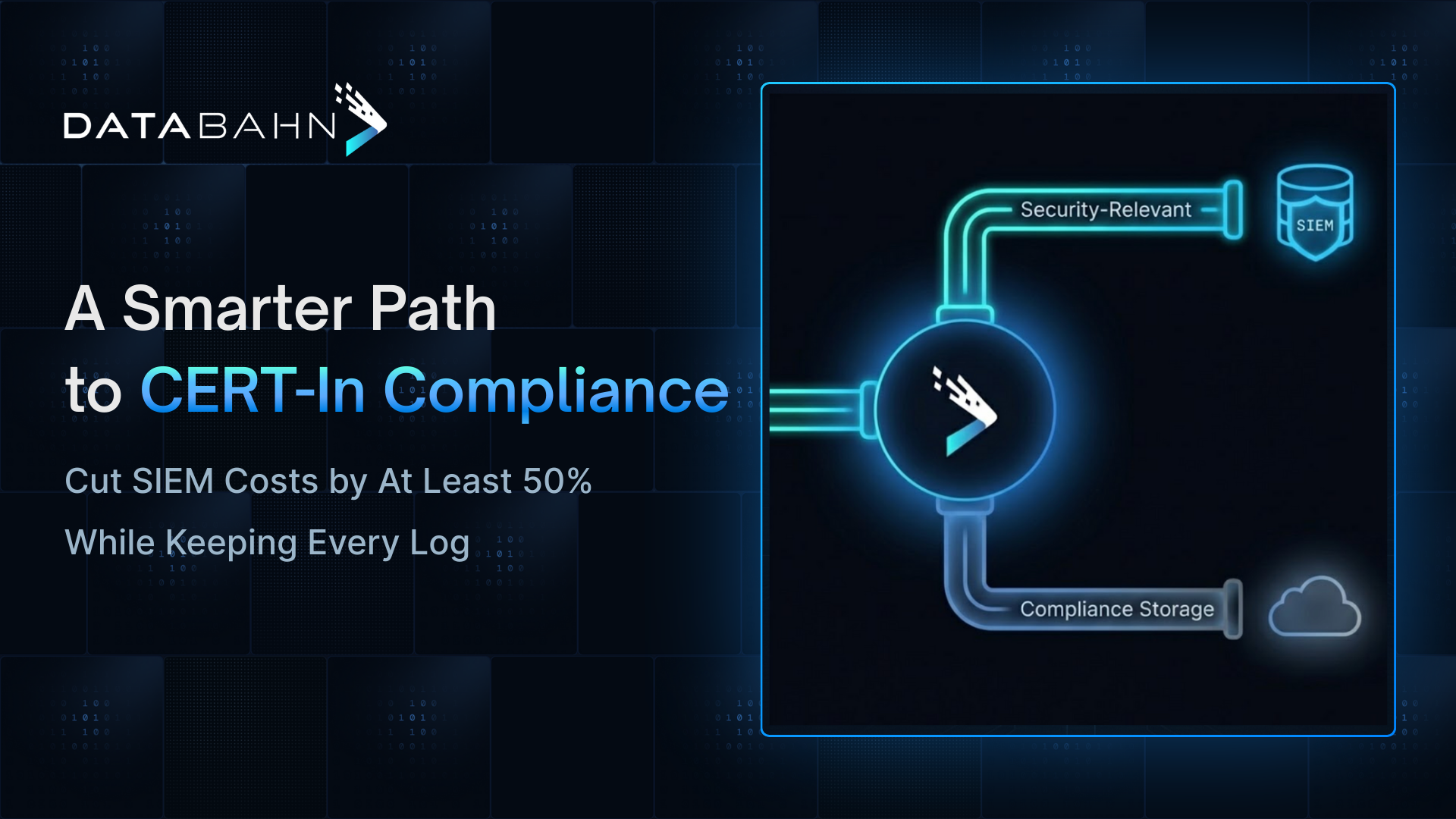
Logs are piling up at 25%+ annual growth, and so are the bills. Indian security teams face a double bind: CERT-In’s directive now mandates 180-day log retention (within India) for compliance, yet storing all that data in a SIEM is prohibitively expensive. Running a SIEM today can feel like paying for every streaming channel 24/7 – even though you only watch a few. SIEM vendors charge by data ingested, so you end up paying for every byte, even the useless noise. It’s no surprise that many enterprises spend crores on SIEM licensing, only to have analysts waste 30% of their time chasing low-value alerts.
“You cannot stop collecting telemetry without creating blind spots, and you cannot keep paying for every byte without draining your budget.”
This catch-22 has left Security Operations Centers (SOCs) struggling. Some try to curb costs by turning off “noisy” data sources (firewalls, DNS, etc.), but that just creates dangerous visibility gaps. Others shorten retention or archive logs offline, but CERT-In’s 180-day rule means dropping data isn’t an option – and retrieving cold archives for an investigation can be painfully slow and costly. The tension is clear: How do you stay compliant and keep full visibility without blowing out your SIEM budget?
Typical quick fixes offer only partial relief and introduce new risks:
All these measures chip away at the problem without solving it. They force security leaders into an unwinnable choice between cost, compliance, and visibility. What’s needed is a way to ingest everything (to satisfy compliance and visibility) while paying only for what truly matters (to control cost).
Instead of sacrificing either logs or budget, forward-thinking teams are turning to Databahn’s intelligent security data pipeline as the connective layer between log sources and the SIEM. This approach keeps every log for compliance but ensures that only the right logs enter your SIEM. By processing data before it hits the SIEM, Databahn ensures high-value, security-relevant events go into premium storage and analytics, while everything else is routed into affordable archives.
Think of it as triage for your telemetry with Databahn at the center:
Key Outcomes with Databahn:
This approach fundamentally changes the economics of security data. By aligning cost with value, teams escape the spiral of ever-increasing SIEM bills. In fact, many enterprises achieve 50–70% lower SIEM ingest volumes within weeks, instantly cutting costs in half. Storage footprints shrink as redundant data gets offloaded, often yielding up to 80% savings on storage spend.
Equally important, analysts get relief from alert fatigue. With noisy logs filtered out upstream, the alerts that reach your SOC are fewer but higher fidelity. Teams spend time on real threats, not on torrents of false positives. Compliance is no longer a headache either: every log is still at your fingertips (just in the right place and at the right price). Predictable budgets replace unpredictable spikes, and security leaders no longer have to choose between “spend more” vs. “see less.”
Real-world adopters of this model have reported results like a 60% reduction in daily ingest (saving ₹3+ crore annually) and an 80% log volume reduction in a global deployment – all while maintaining full visibility. The bottom line: SIEM cost reduction and complete visibility are no longer at odds.
“Cut SIEM costs by half and keep every log – it’s now achievable with the right data pipeline strategy.”
Beyond immediate savings, a modern data pipeline sets you up for the future. Telemetry volumes will keep growing, and regulations like CERT-In will continue evolving. With an intelligent pipeline in place, your organization can scale and adapt with confidence:
In short, pipeline-driven architectures make your SOC more agile, compliant, and cost-efficient. They turn security data management from a bottleneck into a competitive advantage.
Indian enterprises no longer have to choose between meeting CERT-In compliance and controlling SIEM costs. By filtering and routing logs intelligently, you guarantee >50% savings on SIEM and storage spend while retaining 100% of your data for the required 180 days (and beyond). This means no blind spots, no compliance gaps, and no surprise bills – just a leaner, smarter way to handle security telemetry.
Ready to see how this works in practice for your organization? Book a demo now to see it in action.
The world’s data footprint is growing at an astonishing pace – by 2025 we will generate roughly 181 zettabytes of data per year (about 1.45 trillion gigabytes per day). This data deluge spans every device, cloud, and edge node, creating rich insights but also multiplying security and compliance challenges. In such a vast, distributed environment, relying on manual audits and static configurations is no longer tenable. Security teams face a simple fact: as networks grow in size and diversity (cloud, IoT, remote users), traditional perimeter defenses and hand‐crafted rules struggle to keep up. The stakes are high – costly breaches continue to occur when policies lapse. For example, the Equifax breach in 2017 exposed personal information for roughly 147 million people , and Uber’s 2016 hack compromised data for 57 million users. In each case, inconsistent enforcement of data‐handling policies contributed to the problem.
Security and compliance at enterprise scale suffer from several interlocking problems. First, data volume and diversity are exploding. Millions of new devices, microservices, and data flows appear each year (IoT alone will generate nearly half of new data). Second, misconfigurations and human error remain rampant: industry reports find that roughly 80% of security exposures stem from misconfigured credentials or policies. A single missing firewall rule or forgotten configuration – as one incident dubbed “the breach that never happened” illustrates – can linger quietly and eventually enable attackers to slip past defenses. Third, regulatory demands are multiplying. Organizations must simultaneously satisfy frameworks like PCI-DSS, HIPAA, GDPR, and NIST, each requiring specific technical controls (segmentation, encryption, logging, etc.) on a tight schedule. Auditors expect continuous evidence that policies are enforced everywhere across on-premises and cloud networks. In practice, many teams find they lack real-time visibility into policy compliance.
Conventional approaches – shipping everything to a central SIEM or relying on annual audits – simply can’t keep up. When policies are defined in documents rather than machines, enforcement is reactive and errors slip through. The result is “compliance by happenstance” and ever-growing risk.
A policy-driven security fabric is an architectural approach that embeds security and compliance policies directly into the network and data infrastructure, enforcing them automatically and uniformly at scale. Instead of relying on manually configured devices or point tools, a security fabric uses centralized policy definitions that propagate to every relevant element (switch, cloud service, endpoint, etc.) in real time. Key features include:
Unlike legacy systems that “shoot arrows and hope,” a policy-driven fabric automates the chain of trust. When a new application or device comes online, it automatically inherits the relevant policies (for encryption, retention, access, etc.) without manual setup. If a compliance rule changes (e.g. a new data-retention requirement), updating the central policy cascades the change network-wide. This ensures continuous compliance by design.
The move toward policy-driven security fabrics parallels several industry trends:
Real-world incidents highlight why the industry needs this approach. The Equifax breach and Uber cover-up both stemmed from policy gaps. In Uber’s case, hackers stole credentials and exfiltrated data on 57 million users; the company even paid the ransom quietly rather than reporting it. Had a policy-driven fabric been in place (for example, automatically logging and alerting on unauthorized data exfiltration, or enforcing stricter segmentation around customer data), the breach could have been detected or contained sooner. In Equifax’s case, attackers exploited outdated software (no security patch policy) and made off with 147 million records. Today, regulators explicitly require robust patching, encryption, and data-minimization policies – mandates that are easier to meet with automation.
Many organizations are already putting these ideas into practice:
These examples illustrate a common outcome: faster, more reliable compliance. By treating policies as code and applying them uniformly, organizations turn audit prep from a panic-driven scramble into an ongoing automated process.
Implementing a policy-driven fabric requires collaboration between security, network, and compliance teams. Key steps include:
In practice, this often means moving from a checklist mentality (“do we have X control?”) to an architecture where security and compliance are built from the start. Instead of patchy patch management or ad hoc segmentation, the network itself becomes “aware” of compliance constraints.
As data and networks scale to unprecedented levels, manual compliance is a lost cause. A policy-driven security fabric offers a transformative path forward: it embeds compliance into the architecture so that policy enforcement is automatic, continuous, and verifiable. The outcome is security at scale – fewer configuration errors, faster responses, and demonstrable audit trails.
Enterprises that embrace this approach find that compliance can shift from being a cost center to a trust builder. By codifying and automating policies, organizations reduce risk (breaches and fines), save time on audits, and free security teams to focus on strategic defense rather than firefighting. In a world of exploding data and tightening regulations, a policy-driven fabric isn’t just a nice-to-have – it’s the foundation of scalable, future-proof security.
.png)
Teams running a Managed Security Service (MSS) are getting overwhelmed with the complexity of growth. Every new customer adds another SIEM, another region, another compliance regime – and delivers another sleepless night for your operations team.
Across the industry, managed security service providers (MSSPs) are discovering the same truth: the cost of complexity grows faster than the revenue it earns. Every tenant brings its own ingestion rules, detection logic, storage geography, and compliance boundaries. What once made sense for ten customers begins to collapse under the weight of 15, 25, and 40 customers.
This is not a technology failure; it’s an architectural mismatch. MSSPs must contend with and operate multiple platforms and pipelines not generally designed or built for multi-tenancy. They must engage with telemetry architecture that is meant to centralize many sources into a single SIEM, and create ways to federate, manage, and streamline security telemetry in a way that enables SOC operations for multiple users.
For most providers, tenant growth directly maps to operational sprawl. Each client has unique SIEM requirements, volume tiers, and compliance needs. Each requires custom integrations, schema alignment, and endless maintenance.
Three familiar challenges emerge:
It’s the hidden tax of being a multi-tenant provider without a true multi-tenant architecture.
Modern MSSPs need a control model that scales trust, not toil. They need a structured, infrastructure-driven way to give every tenant autonomy while maintaining centralized intelligence and oversight. We’ve built it, and we call it the Beacon Architecture.
At the heart of the Beacon Architecture is a single, federated control plane that can govern hundreds of isolated data planes below it. Each tenant operates independently with its own routing logic, volume policies, and SIEM integrations, yet all inherit global policies, monitoring, and governance from the Beacon.
The idea is simple: building a system that balances the requirement of guiding every tenant’s telemetry in a way that optimizes for tenant control while enabling centralized governance and management. This isn’t a tweak to traditional data routing; it’s a fundamental redesign around five principles:
Each tenant runs its own fully contained data plane – not as a workspace carved out of shared infrastructure. That means you can apply tailored enrichment, normalization, and reduction rules without cross-contamination or schema drift across tenants. Isolation protects autonomy, but the Beacon ensures every tenant still adheres to a consistent governance baseline.
Operationalizing this requires tagging data at the edge of the collection infrastructure, enabling centralized governance systems to isolate data planes based on these tags.
Instead of building custom pipelines and collection infrastructure for every client, MSSPs can define policy templates for each tenant and deploy them across existing integrations to deploy faster and with much lower effort.
A financial services customer in Singapore? Route and store PII for this client in local cloud systems for compliance.
A healthcare customer in Texas? Apply HIPAA-aligned masking at the edge before ingestion.
Tagging and applying policies for PII at the edge will help MSSPs ensure compliance with data localization and PII norms for customers.
The Beacon provides end-to-end observability – data lineage, drift alerts, pipeline health – across all tenants in a single pane of glass. MSSP operators can now easily track, monitor, and manage data movement. When a customer’s schema changes or a connector stalls, it’s detected automatically and surfaced for approval before it affects operations. It’s the difference between reactive monitoring and proactive assurance.
Leverage a mesh architecture to ensure resiliency and scalability, while utilizing agentic AI to proactively detect problems and errors more quickly.
Adding a tenant no longer means adding infrastructure. With a control plane that can spin up isolated data planes on demand, MSSPs can onboard new customers, regions, or sub-brands within hours, not weeks – with zero code duplication. Policy templates and pre-built connectors – including support for different destinations such as SIEMs, SOARs, data lakes, UEBAs, and observability tools – ensures seamless data movement.
Add new tenants through a fast, simple, and flexible process that helps MSSPs focus on providing services and customizations, not on repetitive data engineering.
With isolation and governance handled, MSSPs can now leverage anonymized telemetry patterns across tenants to identify shared threat trends – safely. This federated analytics layer transforms raw, siloed telemetry into contextual knowledge across the portfolio without exposing any customer’s data.
Anonymized pattern tracking to improve security outcomes without adding to the threat surface, thereby growing trust with customers without incurring prohibitively high costs.
Most MSSPs grow linearly; the cost and effort involved in onboarding each new customer constrain expansion and act as a bottleneck. With the bottleneck, the Beacon Architecture lets MSSPs grow exponentially. When operational effort is decoupled from tenant count, every new customer adds value – not workload.
The outcomes are measurable:
When these efficiencies compound across dozens or hundreds of tenants, the economics change completely: lower engineering overhead, predictable cost-to-serve, and capacity to onboard more customers with the same team, and being able to allocate more bandwidth to strategic security instead of data engineering plumbing.
Data sovereignty no longer necessitates the creation of separate environments. By tagging and routing data according to policy, MSSPs can automatically enforce where telemetry lives, which region processes it, and which SIEM consumes it. With Beacon, you can also add logic and rules to route less-relevant data to the right data lake and storage endpoint.
PII detection and masking happen at the edge – before data ever crosses borders – giving MSSPs fine-grained control over localization, privacy, and retention. This will enable MSSPs to simplify serving multinational clients or entering new markets without needing to engineer solutions for local compliance.
In other words: compliance becomes an attribute of the pipeline, not an afterthought of storage.
Every MSSP advertises 24x7 vigilance; few can actually deliver it at the data layer. Most MSSPs use complex workflows, relying on processes, systems, and human expertise to serve their clients. When new sources need to be added, pipelines break, or schemas shift, the tech debt increases, putting pressure on their entire business and operations.
With self-healing pipelines, automated schema-drift detection, lineage tracking across every route, and simplified no-code source addition, the Beacon Architecture provides the foundation to actually guarantee the kind of always-on vigilance fast-moving businesses need.
Engineers can see – and prove – that every event was collected, transformed, enriched, and delivered successfully. MSSPs and their clients can even measure their data coverage against security frameworks and baselines such as MITRE ATT&CK. These features become a differentiator in client renewals, audits, and compliance assessments.
When data is structured, governed, and trusted, it becomes teachable. The same architecture that isolates tenants today can fuel intelligent, cross-tenant analytics tomorrow – from AI-assisted threat correlation to federated reasoning models that learn from patterns across the entire managed estate.
That evolution – from managing tenants to managing intelligence – is where the next wave of MSSP competitiveness will play out.
Enterprises running multiple SIEMs across geographies face the same structural problems as MSSPs: fragmented visibility, inconsistent compliance, and duplicated effort. The Beacon model applies equally well here – CISOs operating multiple SIEMs across geographies can push compliance filtering and policies from the edge, ensuring seamless operations. Each business unit, region, or SOC can maintain its preferred SIEM while the organization gains a unified governance and observability layer – plus the freedom to evaluate or migrate between SIEMs without re-engineering the whole data pipeline.
Beacon Architecture isn’t just a new way to route data – it’s a new way to think about data ownership, autonomy, and assurance in managed security operations. It replaces replication with reuse, fragmentation with federation, and manual oversight with intelligent control. Every MSSP that adopts it moves one step closer to solving the fundamental equation of scale: how to ensure quality operations while adding customers without growing their cost base. They can achieve this by handling more data, and doing so intelligently.
Multi-tenancy isn’t about hosting more customers. It’s about hosting more confidence.
The MSSPs that master federated control today will define the managed security ecosystem tomorrow – guiding hundreds of tenants with the precision, predictability, and intelligence of a single Beacon.
.png)
Every SOC depends on clear, actionable security event logs, but the drive for richer visibility often collides with the reality of ballooning security log volume.
Each new detection model or compliance requirement demands more context inside those security logs – more attributes, more correlations, more metadata stitched across systems. It feels necessary: better-structured security event logs should make analysts faster and more confident.
So teams continue enriching. More lookups, more tags, more joins. And for a while, enriched security logs do make dashboards cleaner and investigations more dynamic.
Until they don’t. Suddenly ingestion spikes, storage costs surge, queries slow, and pipelines become brittle. The very effort to improve security event logs becomes the source of operational drag.
This is the paradox of modern security telemetry: the more intelligence you embed in your security logs, the more complex – and costly – they become to manage.
Security operations once had a simple relationship with data — collect, store, search.
But as threats evolved, so did telemetry. Enrichment pipelines began adding metadata from CMDBs, identity stores, EDR platforms, and asset inventories. The result was richer security logs but also heavier pipelines that cost more to move, store, and query.
The problem isn’t the intention to enrich; it’s the assumption that context must always travel with the data.
Every enrichment field added at ingest is replicated across every event, multiplying storage and query costs. Multiply that by thousands of devices and constant schema evolution, and enrichment stops being a force multiplier; it becomes a generator of noise.
Teams often respond by trimming retention windows or reducing data granularity, which helps costs but hurts detection coverage. Others try to push enrichment earlier at the edge, a move that sounds efficient until it isn’t.
Most organizations enrich at the ingest layer, adding hostnames, geolocation, or identity tags to logs as they enter a SIEM or data platform. It feels efficient, but at scale it’s where volume begins to spiral. Every added field replicates millions of times, and what was meant to make data smarter ends up making it heavier.
The issue isn’t enrichment, it’s how rigidly most teams apply it.
Instead of binding context to every raw event at source, modern teams are moving toward adaptive enrichment, a model where context is linked and referenced, not constantly duplicated.
This is where agentic automation changes the enrichment pattern. AI-driven data agents, like Cruz, can learn what context actually adds analytical value, enrich only when necessary, and retain semantic links instead of static fields.
The result is the same visibility, far less noise, and pipelines that stay efficient even as data models and detection logic evolve.
In short, the goal isn’t to enrich everything faster. It’s to enrich smarter — letting context live where it’s most impactful, not where it’s easiest to apply.
In legacy pipelines, enrichment is a static process. Rules are predefined, transformations are rigid, and every event that matches a condition gets the same expanded schema.
But context isn’t static.
Asset ownership changes. Threat models evolve. A user’s role might shift between departments, altering the meaning of their access logs overnight.
A static enrichment model can’t keep up, it either lags behind or floods the system with stale attributes.
A dynamic enrichment architecture treats context as a living layer rather than a stored attribute. Instead of embedding every data point into every security log, it builds relationships — lightweight references between data entities that can be resolved on demand.
Think of it as context caching: pipelines tag logs with lightweight identifiers and resolve details only when needed. This approach doesn’t just cut cost, it preserves contextual integrity. Analysts can trust that what they see reflects the latest known state, not an outdated enrichment rule from last quarter.
When context is over-applied, it doesn’t just bloat data — it skews analytics.
Correlation engines begin treating repeated metadata as signals. That rising noise floor buries high-fidelity detections under patterns that look relevant but aren’t.
Detection logic slows down. Query times stretch. Mean time to respond increases.
Adaptive enrichment, in contrast, allows the analytics layer to focus on relationships instead of repetition. By referencing context dynamically, queries run faster and correlation logic becomes more precise, operating on true signal, not replicated metadata.
This becomes especially relevant for SOCs experimenting with AI-assisted triage or LLM-powered investigation tools. Those models thrive on semantically linked data, not redundant payloads.
If the future of SOC analytics is intelligent automation, then data enrichment has to become intelligent too.
The urgency is no longer hypothetical.
Security data platforms are entering a new phase of stress. The move to cloud-native architectures, the rise of identity-first security, and the integration of observability data into SIEM pipelines have made enrichment logic both more critical and more fragile.
Each system now produces its own definition of context, endpoint, identity, network, and application telemetry all speak different schemas. Without a unifying approach, enrichment becomes a patchwork of transformations, each one slightly out of sync.
The result? Gaps in detection coverage, inconsistent normalization, and a steady growth of “dark data” — security event logs so inflated or malformed that they’re excluded from active analysis.
A smarter enrichment strategy doesn’t just cut cost; it restores semantic cohesion — the shared meaning across security data that makes analytics work at all.
Adaptive enrichment becomes achievable when pipelines themselves learn.
Instead of following static transformation rules, agents observe how data is used and evolve the enrichment logic accordingly.
For example:
This transforms enrichment from a one-time process into a self-correcting system, one that continuously balances fidelity, performance, and cost.
In the next few years, CISOs and data leaders will face a deeper reckoning with their telemetry strategies.
Data volume will keep climbing. AI-assisted investigations will demand cleaner, semantically aligned data. And cost pressures will force teams to rethink not just where data lives, but how meaning is managed.
The future of enrichment isn’t about adding more fields.
It’s about building systems that understand when and why context matters, and applying it with precision rather than abundance.
By shifting from rigid enrichment at ingest to adaptive, agentic enrichment across the pipeline, enterprises gain three crucial advantages:
This is not a call to collect less — it’s a call to collect more wisely.
At Databahn, this philosophy is built into how the platform treats data pipelines, not as static pathways, but as adaptive systems that learn. Our agentic data layer operates across the pipeline, enriching context dynamically and linking entities without multiplying volume. It allows enterprises to unify security and observability data without sacrificing control, performance, or cost predictability.
In modern security, visibility isn’t about how much data you collect — it’s about how intelligently that data learns to describe itself.

